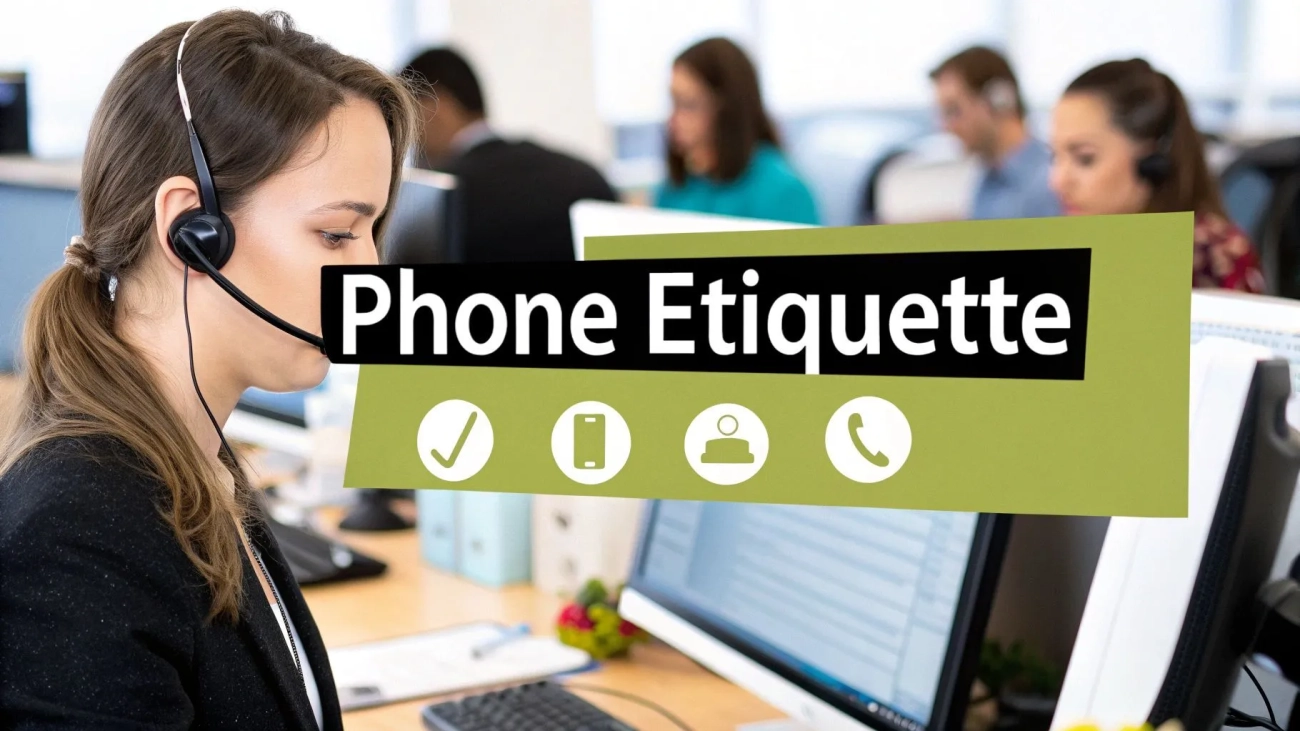
Telephone etiquette is the professional way of answering, speaking, listening, and closing a phone conversation with customers.
Simple training definition:
Telephone etiquette is how we communicate professionally and politely with customers over the phone.
2. Importance of Telephone Etiquette
First impression of the company
Builds customer trust
Shows professionalism
Improves customer satisfaction
Prevents misunderstandings
Helps in problem solving
Very important statement:
On the phone, your voice is your image.
3. Standard Telephone Structure (Very Important)
You can teach this as a simple process:
1. Greeting
2. Introduction
3. Offering Help
4. Listening
5. Responding / Solving
6. Closing
4. Standard Telephone Example
“Good morning, ABC Company, this is Ahmed speaking. How may I assist you today?”
→ Greeting + Introduction + Offer help
5. Situational Examples
Situation 1 – General Enquiry
Customer:
“I want information about your training programs.”
Poor Response:
“Check website.”
Professional Response:
“Thank you for your enquiry. We offer several training programs. May I know which area you are interested in?”
Situation 2 – Putting Customer on Hold
Poor:
“Wait.”
Professional:
“May I place you on hold for a moment while I check that information?”
After returning:
“Thank you for holding.”
Situation 3 – Transferring Call
Professional:
“I will connect you to the relevant department. Please stay on the line.”
Situation 4 – Taking a Message
Professional:
“May I take a message, please?” “Could you please provide your name and contact number?”
Situation 5 – Handling Complaint
Customer:
“Your service is very slow!”
Professional:
“I apologize for the inconvenience. I understand your concern. Let me check this for you immediately.”
Situation 6 – Wrong Number
Professional:
“I’m sorry, I believe you have reached the wrong department. Let me guide you to the correct number.”
Situation 7 – Closing the Call
Professional:
“Thank you for calling ABC Company. Have a great day.”
6. Functional Language (Very Important for Training)
Greeting
Good morning / afternoon
Thank you for calling
Welcome to ABC Company
Offering Help
How may I help you?
How can I assist you today?
What can I do for you?
Asking Questions
May I know your name?
Could you please explain the issue?
Can you provide more details?
Putting on Hold
May I place you on hold for a moment?
Thank you for holding
Transferring Call
I will transfer your call
Please hold while I connect you
Clarifying
Let me confirm that
Just to clarify
Let me check and get back to you
Apologizing
I apologize for the inconvenience
I’m sorry for the delay
Sorry for the inconvenience caused
Closing
Thank you for calling
Have a nice day
We appreciate your call
7. Professional Vocabulary
Word
Meaning
Assist
Help
Enquiry
Asking for information
Clarify
Make clear
Confirm
Check and verify
Transfer
Connect to another person
Hold
Ask customer to wait
Resolve
Solve problem
Escalate
Send to higher authority
Follow up
Check later
Inform
Give information
Update
Give latest information
Request
Ask politely
Respond
Reply
Concern
Problem or issue
Feedback
Customer opinion
8. Do’s and Don’ts of Telephone Etiquette
Do’s:
Answer within 3 rings
Smile while talking
Speak clearly
Use polite words
Listen carefully
Take notes
Confirm information
Be patient
Thank customer
Close professionally
Don’ts:
Do not interrupt
Do not argue
Do not use rude tone
Do not use slang
Do not say “I don’t know”
Do not keep customer waiting without information
Do not eat or chew while talking
Do not sound bored or angry
9. Tone of Voice (Very Important)
Tone should be:
Friendly
Calm
Polite
Confident
Helpful
Bad tone:
Angry
Rude
Bored
Impatient
Important concept:
Customers cannot see you, but they can hear your attitude.
10. Points to Remember (Training Summary)
You can teach these key points:
Answer calls within 3 rings
Always greet and introduce yourself
Speak clearly and politely
Use customer name if possible
Listen carefully
Do not interrupt
Use positive language
Apologize when necessary
Provide correct information
Do not say “I don’t know”
Ask before putting on hold
Thank customer for waiting
Take messages correctly
Close call professionally
Always thank the customer
Very Strong Training Statement
You can tell participants:
On the phone, customers cannot see your face. They judge you only by your voice, tone, and words.
A professional phone call creates trust. A poor phone call loses customers.
If you want, next I can prepare:
Using Polite Words in Telephone Conversations (Workplace)
This section is very useful for training because small word changes create big impact on customer experience.
1. Why Polite Words Are Important
Polite language helps to:
Show respect
Build trust
Reduce customer anger
Create positive experience
Maintain professionalism
Improve customer satisfaction
Very important training statement:
It’s not what you say, it’s how you say it.
2. Basic Polite Words to Use
Employees must regularly use:
Please
Thank you
You’re welcome
My pleasure
Certainly
Of course
I apologize
Kindly
May I…
Could you…
Let me…
I will…
3. Polite vs Impolite Language (Very Important)
Impolite / Direct
Polite / Professional
Wait
Please hold for a moment
I don’t know
Let me check that for you
No
I’m afraid that may not be possible
Call later
Could you please call back later?
Send details
Could you please send the details?
Give me your name
May I have your name, please?
Wrong number
I believe you have reached the wrong department
Not my job
Let me connect you to the right person
4. Functional Polite Language for Telephone Situations
Greeting
“Good morning, thank you for calling ABC Company.”
“Good afternoon, how may I assist you?”
Asking Information
“May I have your name, please?”
“Could you please provide more details?”
“May I know the issue you are facing?”
Putting on Hold
“May I place you on hold for a moment?”
“Thank you for your patience.”
Transferring Call
“I will connect you to the relevant department.”
“Please hold while I transfer your call.”
Clarifying Information
“Let me confirm that for you.”
“Just to clarify your request…”
Apologizing
“I apologize for the inconvenience.”
“I’m very sorry for the delay.”
Offering Help
“Let me assist you with that.”
“I will check this for you immediately.”
Giving Information
“Your order will be delivered tomorrow.”
“The service will take approximately 15 minutes.”
Closing the Call
“Thank you for calling.”
“Have a great day.”
“Please feel free to contact us again.”
5. Situational Examples
Situation 1 – Customer Asking Information
Customer:
“What are your working hours?”
Impolite:
“9 to 5.”
Polite:
“Our working hours are from 9 AM to 5 PM. Please let us know if you need any further assistance.”
Situation 2 – Customer Complaint
Customer:
“Your service is very slow!”
Impolite:
“It’s not slow.”
Polite:
“I apologize for the delay. I understand your concern. Let me check this for you immediately.”
Situation 3 – Putting on Hold
Impolite:
“Wait.”
Polite:
“May I place you on hold for a moment while I check the details?”
Situation 4 – You Don’t Know the Answer
Impolite:
“I don’t know.”
Polite:
“Let me check that information for you and get back to you shortly.”
Situation 5 – Transferring Call
Polite:
“I will transfer your call to the concerned department. Please stay on the line.”
Situation 6 – Ending the Call
Impolite:
“Okay, bye.”
Polite:
“Thank you for calling ABC Company. Have a wonderful day.”
6. Golden Rule in Telephone Communication
You can teach this:
Replace negative words with positive and polite expressions.
7. Tone + Words = Professional Communication
Even polite words must be used with:
Friendly tone
Calm voice
Clear pronunciation
Respectful attitude
Example:
Same sentence, different tone:
“Please wait.”
Rude tone → Sounds negative Polite tone → Sounds professional
8. Points to Remember
You can give this as training summary:
Always use polite words
Avoid direct or rude language
Use “please” and “thank you” frequently
Do not say “I don’t know”
Use positive language
Apologize when necessary
Speak clearly and calmly
Use customer-friendly phrases
Maintain professional tone
End call politely
Words are powerful in customer service.
Polite words create respect. Positive words create satisfaction. Professional words create trust.
One wrong word can lose a customer. One polite word can keep a customer forever.
Below are Telephone Role Plays + Professional Scripts
Telephone Etiquette Role Plays & Scripts
Role Play 1 – General Enquiry
Situation:
Customer calls to ask about services.
❌ Unimpressive Way:
Staff:
“Hello… what?”
Customer:
“I want information.”
Staff:
“Check website.”
✅ Impressive Way (Professional Script):
Staff:
“Good morning, ABC Company, this is Ahmed speaking. How may I assist you today?”
Customer:
“I want information about your training programs.”
Staff:
“Certainly. We offer a range of training programs. May I know which area you are interested in?”
Focus:
Greeting
Tone
Asking questions
Engagement
Role Play 2 – Putting Customer on Hold
Situation:
Staff needs time to check information.
❌ Unimpressive Way:
“Wait.”
(Customer annoyed)
✅ Impressive Way:
“May I place you on hold for a moment while I check the details?”
(After returning) “Thank you for your patience.”
Focus:
Permission
Polite language
Respect
Role Play 3 – Transferring a Call
Situation:
Customer needs another department.
❌ Unimpressive Way:
“Not my department. Call another number.”
✅ Impressive Way:
“I will connect you to the relevant department. Please stay on the line.”
“Thank you for holding. I’m transferring your call now.”
Focus:
Ownership
Professional language
Smooth transition
Role Play 4 – Handling a Complaint
Situation:
Customer complains about late delivery.
Customer:
“My order is late!”
❌ Unimpressive Way:
“Delivery problem. Not my fault.”
✅ Impressive Way:
“I sincerely apologize for the delay. I understand how frustrating this must be. Let me check the status and update you immediately.”
Focus:
Apology
Empathy
Action
Role Play 5 – Taking a Message
Situation:
Person is not available.
❌ Unimpressive Way:
“He is not here. Call later.”
✅ Impressive Way:
“I’m sorry, he is currently unavailable. May I take a message, please?” “Could you please provide your name and contact number?”
Focus:
Politeness
Clarity
Professional handling
Role Play 6 – Wrong Number
Situation:
Customer calls wrong department.
❌ Unimpressive Way:
“Wrong number.”
✅ Impressive Way:
“I believe you have reached the wrong department. Let me guide you to the correct contact number.”
Focus:
Respect
Helpfulness
Role Play 7 – Closing the Call
Situation:
Ending the conversation.
❌ Unimpressive Way:
“Okay bye.”
✅ Impressive Way:
“Is there anything else I can assist you with?” “Thank you for calling ABC Company. Have a wonderful day.”
Focus:
Professional closing
Customer care
Role Play 8 – Customer Asking for Discount
Situation:
Customer requests a discount.
Customer:
“Can you give me a discount?”
❌ Unimpressive Way:
“No.”
✅ Impressive Way:
“Thank you for your interest. At the moment, we have a fixed pricing policy. However, we do have special offers during certain periods. I can inform you when they are available.”
Focus:
Saying “No” politely
Maintaining relationship
Role Play 9 – Busy Line / Delay
Situation:
Customer complains about delay.
Customer:
“I’ve been waiting too long!”
❌ Unimpressive Way:
“Busy.”
✅ Impressive Way:
“I sincerely apologize for the delay and thank you for your patience. We are currently experiencing high call volume. How may I assist you now?”
Focus:
Apology
Appreciation
Professional tone
Role Play 10 – Follow-Up Call
Situation:
Staff calls customer after service.
✅ Professional Script:
“Good afternoon, this is Ahmed from ABC Company. I’m calling to check if the issue we resolved yesterday is working fine now.”
Focus:
Customer care
Relationship building
Key Learning Points
First impression is created in first 5 seconds
Tone of voice is very important
Use polite and positive language
Always listen carefully
Never argue
Apologize when needed
Provide solutions
Take ownership
Close calls professionally
Every call represents the company
Every phone call is an opportunity.
A poor call loses a customer. A professional call builds trust.
You are not just answering a call. You are representing the company.
Comprehensive Conceptual Overview of Supply Chain Management with Drivers, Cycles, and OTP Framework
This article combines everything we discussed earlier into one complete conceptual article so that this can be used for your Talent Consultancy blog, training material, and consulting framework.
At Talent Consultancy, we explain Supply Chain Management not as separate functions like procurement, logistics, inventory, and warehouse, but as an integrated performance system driven by drivers, cycles, and the OTP Framework.
1. Concept of Supply Chain Management
Supply Chain Management is the management of:
Material flow
Information flow
Financial flow
Suppliers
Procurement
Production
Inventory
Warehousing
Transportation
Distribution
Customer service
Returns
Three Main Flows in Supply Chain
Flow
Direction
Product Flow
Supplier → Customer
Information Flow
Customer → Supplier
Financial Flow
Customer → Supplier
So supply chain is not a line — it is a network of flows and activities.
2. Supply Chain Drivers (Cost and Service Performance Factors)
Supply chain performance is determined by six supply chain drivers:
Supply Chain Driver
Description
Facilities
Factories, warehouses, distribution centers
Inventory
Raw materials, WIP, finished goods
Transportation
Movement of goods
Information
Data, forecasting, planning systems
Sourcing
Supplier selection and procurement
Pricing
Discounts, promotions, demand management
These drivers determine:
Supply chain cost
Service level
Responsiveness
Efficiency
Profitability
Explanation of Each Driver
Facilities
Facilities include warehouses, factories, and distribution centers.
Facility decisions:
Number of warehouses
Warehouse location
Capacity
Factory location
Distribution network design
Impact:
More facilities → Faster delivery + Higher cost
Fewer facilities → Lower cost + Slower delivery
So facilities affect cost vs service level.
Inventory
Inventory includes:
Raw materials
Work in progress
Finished goods
Safety stock
Buffer stock
Seasonal stock
Transit inventory
Inventory exists because:
Demand uncertainty
Supply uncertainty
Lead time delays
Bulk purchasing
Seasonal demand
Inventory affects:
Holding cost
Service level
Working capital
Stock availability
Inventory is a buffer between supply and demand.
Transportation
Transportation includes:
Road
Rail
Sea
Air
Transportation decisions:
Mode selection
Route planning
Shipment size
Delivery frequency
Fleet utilization
Impact:
Fast transport → High cost
Slow transport → Low cost
Transportation affects:
Logistics cost
Delivery time
Inventory levels
Customer service
Information
Information is the most important driver.
Information includes:
Demand forecasting
Inventory levels
Order status
Supplier performance
Production schedule
Shipment tracking
Cost information
Good information:
Reduces uncertainty
Reduces inventory
Improves planning
Improves coordination
Reduces cost
Improves service level
Information connects all supply chain drivers.
Sourcing
Sourcing includes:
Supplier selection
Make or buy decisions
Local vs global sourcing
Contract management
Supplier relationship management
Sourcing affects:
Material cost
Lead time
Quality
Reliability
Supply risk
Pricing
Pricing includes:
Discounts
Promotions
Seasonal pricing
Bulk discounts
Credit terms
Pricing affects:
Demand level
Demand variability
Order quantity
Inventory levels
Transportation frequency
So pricing affects demand patterns, which affect supply chain operations.
3. Supply Chain Cycles (Process View of Supply Chain)
Supply chain processes operate in cycles between supply chain partners.
Operations → Visibility → Accountability → Control → Cost Reduction + Service Improvement → Customer Satisfaction → Revenue → Profit → Business Performance
Final Strategic Conclusion
Supply chain management should not be managed as separate departments like procurement, logistics, warehouse, and inventory. It should be managed as a system of drivers, cycles, flows, and performance controls.
At Talent Consultancy, we summarize the entire supply chain and OTP framework in one concept:
“If an organization improves visibility, accountability, and control over procurement, inventory, warehouse, and logistics operations, cost will reduce, service level will improve, customers will be satisfied, and profitability and business performance will automatically improve.”
Final Thought
Many organizations try to improve profit by increasing sales, but smart organizations improve profit by improving supply chain operations. Sales brings revenue, but supply chain controls cost, service level, and operational efficiency.
Companies do not become profitable because they sell more.
They become profitable because they manage operations better through visibility, accountability, and control.
Procurement Contracts Management: Controlling Agreements to Reduce Risk, Control Cost, and Improve Business Performance
In procurement, many organizations focus on supplier selection, price negotiation, and purchasing, but they often forget one very important area: contract management. A contract is not just a document; it is a legal and operational agreement that controls price, delivery, quality, payment terms, penalties, and responsibilities between the organization and the supplier.
If contracts are not properly managed, organizations may face price disputes, delivery delays, quality issues, legal disputes, and financial losses. Therefore, Procurement Contracts Management is a very important part of procurement and supply chain management.
Procurement Contracts Management ensures that supplier agreements are clear, controlled, monitored, and properly executed.
What Procurement Contracts Management Means
Procurement Contracts Management is the process of:
Preparing procurement contracts
Negotiating contract terms and conditions
Reviewing and approving contracts
Monitoring contract performance
Managing contract changes
Managing contract risks
Ensuring contract compliance
Renewing or closing contracts
The contract defines:
Price and payment terms
Delivery terms
Quality standards
Service level agreements (SLAs)
Penalties for late delivery
Warranty terms
Contract duration
Responsibilities of both parties
Dispute resolution process
A good contract protects both the buyer and the supplier and ensures smooth business operations.
Why Procurement Contracts Management Is Important
If procurement contracts are not properly managed, organizations may face many problems:
Suppliers increase prices unexpectedly
Delivery delays without penalties
Poor quality materials or services
Payment disputes
Contract expiry without renewal
Legal disputes
No service level control
Unclear responsibilities
Risk exposure
Financial losses
Many organizations sign contracts and then file them without monitoring. This is a major mistake. A contract must be actively managed, not just signed.
Business Example
Consider a company that signed a contract with a logistics service provider for transportation services. The contract included delivery timelines and penalty clauses for late delivery, but the company never monitored delivery performance.
Over time:
Deliveries were frequently delayed
Customers complained
The company lost business
No penalties were applied because contract performance was not monitored
Later, the company implemented contract management practices:
Contract performance tracking
Service level monitoring
Monthly review meetings with supplier
Penalty clauses enforced
Contract renewal based on performance
After implementing contract management:
Delivery performance improved
Service quality improved
Supplier accountability increased
Operational performance improved
This shows that contracts must be managed, not just signed.
Procurement Contracts Management and the OTP Framework
Procurement Contracts Management fits very well with the OTP Framework (Operations → Transparency → Profit).
1. Visibility (Seeing Contract Information Clearly)
Organizations must have visibility of:
Contract terms
Contract value
Contract duration
Price agreements
Delivery terms
Service level agreements
Penalty clauses
Contract performance
Contract expiry dates
Renewal dates
When contract information is visible:
Contracts can be monitored
Expiry dates are not missed
Performance can be evaluated
Risks can be controlled
Visibility prevents many contract-related problems.
2. Accountability (Responsibility for Contract Management)
Clear responsibility must be assigned:
Who prepares contracts
Who reviews contracts
Who approves contracts
Who monitors contract performance
Who manages contract changes
Who handles disputes
Who manages contract renewal
When accountability is clear:
Contracts are properly managed
Supplier performance improves
Disputes reduce
Contract compliance improves
3. Control (Managing Contracts Systematically)
Contract management must be controlled through:
Standard contract templates
Contract approval procedures
Contract performance monitoring
Service level agreement tracking
Contract change management procedures
Contract renewal procedures
Contract documentation system
Legal review procedures
Contract audit
Control ensures contracts are managed professionally and systematically.
4. Profit (Result of Good Contract Management)
When procurement contracts are properly managed:
Prices remain controlled
Delivery performance improves
Service levels improve
Penalties can be enforced
Risks reduce
Legal problems reduce
Supplier accountability increases
Operational efficiency improves
All these improvements lead to better financial performance and profitability.
Types of Procurement Contracts
Organizations commonly use different types of contracts such as:
1. Fixed Price Contract
Price is fixed and does not change during the contract period.
2. Cost Plus Contract
Supplier is paid cost plus a profit margin.
3. Framework Agreement
Long-term agreement with agreed prices and terms; orders are placed when needed.
4. Service Contract
Used for services like maintenance, logistics, cleaning, IT support, etc.
5. Blanket Purchase Agreement
Used for repetitive purchases over a period of time.
6. Performance-Based Contract
Supplier payment depends on performance levels.
Each contract type is used depending on the type of purchase and risk level.
Key Elements of a Good Procurement Contract
A good procurement contract should include:
Scope of work
Price and payment terms
Delivery terms
Quality standards
Service level agreements
Penalties and liquidated damages
Warranty terms
Contract duration
Termination conditions
Dispute resolution
Confidentiality clause
Force majeure clause
Insurance requirements
These elements protect the organization from financial and operational risks.
Common Contract Management Mistakes
Organizations should avoid the following mistakes:
Signing contracts without legal review
Not monitoring contract performance
Missing contract expiry dates
Not enforcing penalty clauses
Not documenting contract changes
Poor contract record keeping
Not reviewing contracts regularly
Not linking contracts to supplier performance
Avoiding these mistakes improves procurement performance significantly.
Final Thought
Procurement contracts are not just legal documents; they are business control tools that manage cost, delivery, quality, service, and risk.
When Procurement Contracts Management is implemented properly:
Contract information becomes visible
Responsibility becomes clear
Contracts are controlled
Supplier performance improves
Risks reduce
Costs are controlled
Operations improve
Profit increases
At Talent Consultancy, we help organizations develop procurement contract templates, contract management systems, service level agreements, contract performance monitoring systems, and contract risk management frameworks to improve procurement performance and business profitability.
Because when contracts are properly managed: Costs are controlled, risks are reduced, supplier performance improves, and business operations become stable and profitable.
The same way: provide an article about procurement risk management
Negotiation Creates Value, and Contracts Protect Value – The Role in Business Performance
In procurement management, one important principle explains the impact of procurement on business performance:
Negotiation creates value, and contracts protect value.
Many organizations select suppliers and place orders, but they do not focus enough on negotiation strategy and contract management. However, the real financial and operational benefits of procurement come from how well the organization negotiates and how well contracts are structured, implemented, and monitored.
At Talent Consultancy, we help organizations develop procurement negotiation strategies, supplier contract frameworks, service level agreements, contract management systems, and supplier performance monitoring frameworks that improve supplier performance and overall business performance.
Let us clearly understand how negotiation creates value and how contracts protect value.
1. How Negotiation Creates Value
Procurement negotiation is not just bargaining for a lower price. Professional procurement negotiation creates value in many areas of business operations.
Price Value
Through negotiation, procurement can achieve:
Lower purchase price
Volume discounts
Long-term price agreements
Framework agreements
Cost reduction through value engineering
Total cost of ownership reduction
This directly improves profit margins.
Payment Terms Value
Negotiation can improve payment terms such as:
30 days → 60 days → 90 days credit
Partial payments
Payment after delivery
Payment after inspection
Reduced advance payments
Better payment terms improve cash flow and working capital, which improves financial performance.
Delivery and Inventory Value
Negotiation can include:
Delivery schedules
Shorter lead times
Emergency delivery agreements
Vendor Managed Inventory (VMI)
Consignment stock
Safety stock held by supplier
This reduces:
Inventory cost
Stockouts
Production stoppages
Urgent purchasing costs
This improves operational efficiency.
Quality and Service Value
Negotiation can include:
Quality standards
Inspection procedures
Replacement policies
Warranty terms
Service level agreements (SLAs)
Technical support
Training support
This improves product quality and customer satisfaction.
Risk Reduction Value
Negotiation can include:
Late delivery penalties
Performance guarantees
Insurance requirements
Backup supply arrangements
Dispute resolution methods
Force majeure clauses
This reduces supply chain, legal, and financial risks.
Summary: Value Created Through Negotiation
Negotiation Area
Value Created
Price
Cost reduction
Payment terms
Cash flow improvement
Delivery
Operational efficiency
Quality
Customer satisfaction
Service
Supplier support
Risk
Business continuity
Warranty
Cost protection
Logistics
Cost reduction
Inventory
Working capital reduction
Therefore, negotiation creates financial, operational, and strategic value for the organization.
This is why we say:
Negotiation Creates Value
2. How Contracts Protect Value
After negotiation, all agreed terms must be written in a formal supplier contract. If negotiations create value but contracts are weak, the organization may lose the value that was negotiated.
A contract protects the organization by making all negotiated terms legally enforceable and operationally controllable.
Contracts Protect Price Agreements
If price agreements are not documented:
Supplier may increase prices
Hidden costs may appear
Payment disputes may arise
Contracts protect:
Agreed price
Discount structure
Price validity period
Price adjustment formula
This protects cost savings.
Contracts Protect Delivery Agreements
Contracts include:
Delivery schedules
Lead times
Incoterms
Transportation responsibility
Late delivery penalties
This protects supply continuity and operational planning.
Contracts Protect Quality Standards
Contracts include:
Quality specifications
Inspection requirements
Rejection procedures
Replacement responsibility
Warranty terms
This protects product and service quality.
Contracts Protect Payment Terms
Contracts include:
Payment period
Payment method
Currency
Penalties for late payment
Dispute handling
This protects cash flow agreements.
Contracts Protect Against Risks
Contracts include:
Penalty clauses
Liquidated damages
Insurance requirements
Confidentiality clauses
Force majeure
Termination clauses
Dispute resolution
This protects the organization from legal and financial risks.
Summary: Value Protected Through Contracts
Contract Area
Value Protected
Price
Cost savings
Delivery
Operational continuity
Quality
Product/service quality
Payment terms
Cash flow
Penalties
Supplier performance
Warranty
Cost protection
Risk clauses
Legal protection
SLAs
Service performance
Therefore:
Contracts Protect Value
3. Negotiation + Contract = Business Performance
When negotiation and contracting are managed properly, the organization achieves:
Lower procurement costs
Better payment terms
Reliable delivery
Better supplier performance
Reduced risks
Better quality
Improved operations
Better supplier relationships
Improved customer satisfaction
Higher profitability
Improved business performance
This shows that procurement negotiations and contracting directly influence business performance.
4. Strategic Conclusion
We can summarize procurement impact on business performance like this:
Procurement Activity
Business Impact
Strategic sourcing
Right suppliers
Negotiation
Value creation
Contracting
Value protection
Supplier management
Performance improvement
Procurement planning
Cost control
Procurement risk management
Business continuity
Procurement performance management
Efficiency
Procurement strategy
Competitive advantage
Final Conclusion
In procurement:
Strategic sourcing finds the right suppliers
Negotiation creates value
Contracts protect value
Supplier management delivers value
Procurement strategy improves business performance
That is why modern organizations consider procurement as a strategic function, not a purchasing department.
And the most important principle to remember:
Negotiation Creates Value, Contracts Protect Value, Procurement Improves Business Performance.
The Role of Procurement Negotiations and Contracting with Suppliers in Business Performance
In procurement management, two activities have a direct and powerful impact on business performance: procurement negotiations and supplier contracting. Many organizations focus only on purchasing and supplier selection, but the real value in procurement often comes from how well the organization negotiates and how well contracts are structured and managed.
Good negotiations and well-designed contracts can reduce costs, reduce risks, improve supplier performance, ensure delivery reliability, improve quality, and protect the organization legally and financially. Poor negotiations and weak contracts can lead to high costs, disputes, delivery failures, quality problems, and financial losses.
Therefore, procurement negotiations and contracting are not administrative tasks — they are strategic business performance tools.
Procurement Negotiations in Business Performance
Procurement negotiation is the process of discussing and agreeing with suppliers on:
Price
Delivery schedule
Payment terms
Quality standards
Service levels
Contract terms
Warranty
Penalties
Discounts
Logistics responsibilities
Risk sharing
Negotiation should not focus only on price; it should focus on total value and long-term relationship.
How Procurement Negotiations Improve Business Performance
1. Cost Reduction
Through negotiation, procurement can achieve:
Lower prices
Volume discounts
Long-term pricing agreements
Reduced logistics costs
Better payment terms
Reduced total cost of ownership
Cost reduction directly improves profitability.
2. Improved Payment Terms and Cash Flow
Procurement negotiations can improve:
Credit period (30 days → 60 days → 90 days)
Installment payments
Advance payment reduction
Payment based on delivery or performance
Better payment terms improve cash flow and working capital management.
3. Delivery and Lead Time Improvement
Negotiation can include:
Delivery schedules
Lead time agreements
Emergency delivery support
Safety stock agreements
Vendor managed inventory
This improves operational efficiency and customer service.
4. Quality and Service Level Agreements
Negotiation can include:
Quality standards
Inspection requirements
Defect rate limits
Replacement policies
Warranty
Service level agreements (SLAs)
This improves product quality and supplier accountability.
5. Risk Reduction
Negotiation can include:
Penalty clauses for late delivery
Performance guarantees
Insurance requirements
Force majeure clauses
Dispute resolution mechanisms
Contract termination clauses
This reduces legal, financial, and operational risks.
Role of Contracting with Suppliers
After negotiations, everything must be documented in a formal contract. A contract protects both the buyer and the supplier and ensures that all negotiated terms are legally enforceable.
A supplier contract usually includes:
Scope of supply
Price and payment terms
Delivery terms
Quality requirements
Service level agreements
Penalties and liquidated damages
Warranty terms
Confidentiality clauses
Termination clauses
Dispute resolution
Force majeure
Contract duration
Renewal terms
A good contract converts negotiation agreements into legal protection and operational control.
Procurement Negotiations, Contracting, and the OTP Framework
Procurement negotiations and contracting strongly support the OTP Framework (Operations → Transparency → Profit).
1. Visibility (Clear Terms and Agreements)
Negotiations and contracts create visibility into:
Pricing structure
Delivery schedules
Payment terms
Quality standards
Service levels
Penalties
Contract obligations
Risk responsibilities
Visibility ensures everyone understands supplier obligations and company obligations.
2. Accountability (Defined Responsibilities)
Contracts clearly define:
Supplier responsibilities
Buyer responsibilities
Delivery responsibilities
Quality responsibilities
Payment responsibilities
Risk responsibilities
This creates accountability and reduces misunderstandings and disputes.
3. Control (Legal and Operational Control)
Contracts provide control through:
Penalty clauses
Performance KPIs
Service level agreements
Delivery schedules
Quality requirements
Contract monitoring
Contract renewal reviews
Control ensures suppliers perform according to agreed terms and conditions.
4. Profit (Financial and Operational Benefits)
Procurement negotiations and contracts improve profit by:
Reducing procurement costs
Improving payment terms
Improving supplier performance
Reducing risks
Reducing disputes
Improving operational efficiency
Improving supply reliability
Improving quality
Supporting business growth
Negotiations and contracts therefore directly improve profitability and business performance.
Common Negotiation and Contracting Mistakes
Organizations often make mistakes such as:
Negotiating only on price
Not negotiating payment terms
Not negotiating delivery terms
Not including penalty clauses
Not including service level agreements
Not documenting agreements properly
Using poor contract templates
Not monitoring contract performance
Not reviewing contracts regularly
These mistakes lead to supplier problems, disputes, and financial losses.
Strategic Importance of Procurement Negotiations and Contracting
Procurement negotiations and contracting help organizations:
Reduce procurement costs
Improve cash flow
Improve supplier performance
Reduce risks
Improve delivery reliability
Improve product/service quality
Improve supplier relationships
Improve operational efficiency
Improve business performance
Improve profitability
Negotiation and contracting are therefore strategic procurement tools.
Final Thought
Supplier selection is important, but negotiation and contracting determine the real value of the supplier relationship.
Even a good supplier can become a problem with a poor contract. Even an average supplier can perform well with a strong contract and clear agreements.
When procurement negotiations and contracting are managed properly:
Costs reduce
Payment terms improve
Delivery improves
Quality improves
Risks reduce
Supplier performance improves
Operations improve
Business performance improves
Profitability increases
At Talent Consultancy, we help organizations develop procurement negotiation strategies, supplier contract frameworks, service level agreements, contract management systems, and supplier performance monitoring frameworks that improve supplier performance and overall business performance.
Because in procurement: Negotiation creates value, and contracts protect value.
Procurement Negotiations Management: Controlling Cost, Creating Value, and Improving Profitability
In every organization, procurement involves spending money. Every purchase—whether raw materials, services, equipment, or supplies—has a direct impact on cost and ultimately on profit. However, many organizations focus only on placing orders and selecting suppliers, without giving enough attention to one of the most powerful activities in procurement: negotiation.
Procurement negotiation is not just about asking for a lower price. It is about creating value, building long-term supplier relationships, managing risks, and achieving the best possible overall deal for the organization.
Organizations that manage procurement negotiations effectively can significantly reduce costs, improve supplier performance, and strengthen their competitive position.
What Procurement Negotiations Management Really Means
Procurement Negotiations Management is the process of:
Preparing for negotiations with suppliers
Analyzing cost structures and market conditions
Negotiating prices, terms, and conditions
Managing contracts and agreements
Building long-term supplier relationships
Monitoring negotiated outcomes
Negotiation is not a one-time activity. It is a continuous process that requires planning, strategy, communication skills, and performance tracking.
Good procurement negotiation focuses on:
Price
Payment terms
Delivery terms
Quality standards
Service levels
Lead times
Volume discounts
Risk sharing
Contract conditions
The objective is not just to reduce cost, but to achieve the best overall value for the organization.
What Happens When Negotiations Are Not Managed Properly
When procurement negotiations are weak or unstructured, organizations face several problems:
Paying higher prices than necessary
Accepting unfavorable contract terms
Poor delivery performance
Lack of flexibility from suppliers
Poor quality standards
No cost savings over time
Weak supplier relationships
Increased dependency on suppliers
Higher operational risk
In many organizations, procurement staff simply accept supplier quotations without proper negotiation. This leads to uncontrolled spending and reduced profit.
Business Example
Consider a company purchasing packaging materials from multiple suppliers. The procurement team was placing orders based on quotations without negotiating effectively.
As a result:
Prices varied between suppliers
No volume discounts were applied
Payment terms were not optimized
Costs increased over time
The company decided to improve procurement negotiation practices:
Analyzed historical purchase data
Consolidated demand to increase negotiation power
Compared supplier pricing
Negotiated long-term contracts
Negotiated bulk discounts
Improved payment terms
Conducted regular supplier negotiations
After implementing these practices:
Procurement costs reduced significantly
Supplier terms improved
Payment flexibility increased
Supplier relationships strengthened
Overall cost efficiency improved
The company improved profit not by increasing sales, but by negotiating better.
Procurement Negotiations Management and the OTP Framework
Procurement negotiation is a key area where the OTP Framework (Operations → Transparency → Profit) can create strong impact.
1. Visibility (Understanding Costs and Supplier Data)
Before negotiation, organizations must have visibility of:
Purchase history
Supplier pricing trends
Market price benchmarks
Volume of purchases
Supplier performance
Contract terms
Total cost of ownership
With visibility:
Negotiations become data-driven
Better decisions can be made
Cost-saving opportunities can be identified
2. Accountability (Responsibility for Negotiation Outcomes)
Clear responsibility must be assigned:
Who is responsible for negotiations
Who approves negotiated contracts
Who monitors supplier performance
Who tracks cost savings
When accountability is clear:
Negotiations become professional
Results are measurable
Performance improves
Cost savings become consistent
3. Control (Structured Negotiation Process)
Negotiations must be controlled through:
Negotiation strategies
Approval of negotiation terms
Standard contract templates
Documentation of agreements
Supplier performance monitoring
Review and renewal processes
Procurement policies
Control ensures negotiations are planned, structured, and aligned with organizational goals.
4. Profit (Result of Effective Negotiation)
When procurement negotiations are managed properly:
Purchase costs reduce
Payment terms improve
Supplier performance improves
Operational efficiency improves
Risks reduce
Total cost of ownership reduces
All these improvements lead directly to higher profitability.
Key Procurement Negotiation Strategies
Organizations can improve negotiation outcomes by using the following strategies:
1. Preparation
Analyze spend data
Understand supplier market
Define negotiation objectives
2. Volume Consolidation
Combine purchases to increase bargaining power
3. Competitive Bidding
Use multiple suppliers to create competition
4. Long-Term Contracts
Secure better pricing through long-term agreements
5. Total Cost Approach
Consider not only price but also quality, delivery, and service
6. Relationship-Based Negotiation
Build trust with suppliers for better long-term benefits
7. Win-Win Negotiation
Ensure both organization and supplier benefit
Negotiation as a Strategic Skill
Procurement negotiation is not just a technical activity. It is a strategic business skill that requires:
Communication skills
Analytical thinking
Market knowledge
Relationship management
Confidence and professionalism
Organizations that invest in negotiation skills gain a strong advantage in cost control and supplier management.
Common Negotiation Mistakes
Organizations should avoid:
Accepting first quotation without negotiation
Focusing only on price
Ignoring supplier relationship
Not preparing for negotiation
Not using data
Not comparing suppliers
Not reviewing contracts
Not tracking negotiated results
Avoiding these mistakes improves procurement performance significantly.
Final Thought
Procurement negotiation is one of the most powerful tools to improve profitability. Every successful negotiation directly reduces cost and increases value.
When Procurement Negotiations Management is implemented properly:
Costs become visible
Responsibility becomes clear
Negotiation processes become controlled
Supplier relationships improve
Cost savings increase
Operational efficiency improves
Profit increases
At Talent Consultancy, we help organizations develop procurement negotiation strategies, train procurement teams, design negotiation frameworks, and implement cost-saving systems that improve procurement performance and profitability.
Because when procurement negotiations are managed properly: Costs reduce, value increases, supplier relationships improve, and profit becomes predictable.
Procurement Process Management: Controlling Purchasing to Improve Cost, Efficiency, and Business Performance
In many organizations, procurement is treated as a simple activity—when a department needs something, they request it, and the procurement department purchases it. However, in well-managed organizations, procurement is not just purchasing; it is a structured process that controls spending, supplier selection, cost management, risk management, and operational efficiency.
Procurement Process Management is therefore not just about buying; it is about managing the entire procurement process systematically from identifying a need to final payment and supplier evaluation.
Organizations that manage procurement processes properly can reduce costs, improve supplier performance, avoid delays, prevent fraud, and improve overall operational performance.
What Procurement Process Management Means
Procurement Process Management refers to the systematic management of all steps involved in purchasing goods and services for an organization.
The procurement process usually includes:
Need identification
Purchase requisition
Approval process
Supplier sourcing
Request for quotation (RFQ) / Tender
Supplier evaluation
Negotiation
Purchase order creation
Order follow-up / Expediting
Goods receipt
Inspection / Quality check
Invoice verification
Payment
Supplier performance evaluation
Managing these steps properly ensures that procurement is controlled, transparent, and efficient.
Why Procurement Process Management Is Important
If procurement processes are not properly managed, organizations face many problems:
Unauthorized purchases
Buying at high prices
Selecting wrong suppliers
Delayed purchases
Emergency purchases
Poor quality materials
Duplicate orders
Invoice mismatches
Payment errors
Fraud and corruption risks
Poor record keeping
Budget overruns
Poor procurement processes lead to high costs, operational delays, and financial losses.
Good procurement process management leads to:
Cost control
Proper approvals
Better supplier selection
Reduced risks
Better record keeping
Budget control
Operational efficiency
Better supplier performance
Improved profitability
Example of Poor Procurement Process
Consider a company where procurement processes are not controlled:
Departments directly call suppliers and place orders
No proper approval system
Prices are not compared
No purchase orders are issued
Goods are received without inspection
Invoices are paid without verification
This creates many problems:
Company pays higher prices
Duplicate purchases
Poor quality materials
Fraud risks
Budget overruns
No procurement records
Difficult to control spending
This is a common situation in many organizations.
Procurement Process Management and the OTP Framework
Procurement Process Management fits very well with the OTP Framework (Operations → Transparency → Profit).
1. Visibility (Seeing the Procurement Process Clearly)
Organizations must have visibility of:
Purchase requests
Approval status
Supplier quotations
Purchase orders
Delivery status
Goods received
Invoices
Payments
Procurement spending
Supplier performance
When procurement is visible:
Spending can be controlled
Delays can be identified
Supplier performance can be monitored
Fraud can be reduced
Procurement planning improves
Visibility is the first step in procurement control.
2. Accountability (Responsibility in Procurement Process)
Clear responsibilities must be assigned:
Who creates purchase requisitions
Who approves purchases
Who selects suppliers
Who negotiates prices
Who issues purchase orders
Who receives goods
Who checks quality
Who verifies invoices
Who approves payments
When accountability is clear:
Procurement becomes controlled
Errors reduce
Fraud risk reduces
Process becomes faster
Responsibility becomes clear
3. Control (Managing Procurement Through Procedures and Policies)
Procurement must be controlled through:
Procurement policy
Approval limits
Supplier selection procedures
Quotation comparison procedures
Purchase order system
Goods receipt procedures
Invoice verification procedures
Payment approval procedures
Procurement audit
Procurement performance KPIs
Control ensures procurement is systematic, transparent, and efficient.
4. Profit (Result of Good Procurement Management)
When procurement processes are managed properly:
Purchase prices reduce
Emergency purchases reduce
Supplier performance improves
Inventory planning improves
Operational delays reduce
Budget control improves
Financial control improves
Overall costs reduce
All these improvements lead to higher profitability.
Many companies increase profit not by increasing sales, but by improving procurement control and reducing purchasing costs.
Key Procurement Process Documents
Important procurement documents include:
Purchase Requisition (PR)
Request for Quotation (RFQ)
Quotation Comparison Sheet
Purchase Order (PO)
Delivery Note
Goods Received Note (GRN)
Inspection Report
Supplier Invoice
Payment Voucher
Supplier Performance Report
These documents ensure procurement is properly recorded and controlled.
If this process is properly managed, procurement becomes efficient, controlled, and cost-effective.
Common Procurement Process Improvements
Organizations can improve procurement by:
Implementing procurement policies and procedures
Creating approval authority matrix
Using quotation comparison sheets
Creating approved supplier lists
Implementing purchase order systems
Tracking supplier delivery performance
Conducting procurement audits
Using procurement KPIs
Implementing ERP procurement systems
Training staff on procurement procedures
These improvements significantly improve procurement performance.
Final Thought
Procurement is not just buying; procurement is spending company money, and therefore it must be properly controlled and managed through structured processes.
When Procurement Process Management is implemented properly:
Procurement becomes visible
Responsibility becomes clear
Procurement processes become controlled
Costs reduce
Supplier performance improves
Operational delays reduce
Financial control improves
Profit increases
At Talent Consultancy, we help organizations develop procurement policies, procurement procedures, approval systems, procurement process flows, supplier selection systems, and procurement performance measurement systems to improve cost control, operational efficiency, and business performance.
Because when procurement processes are properly managed: Costs reduce, operations improve, risks reduce, and profitability increases.