
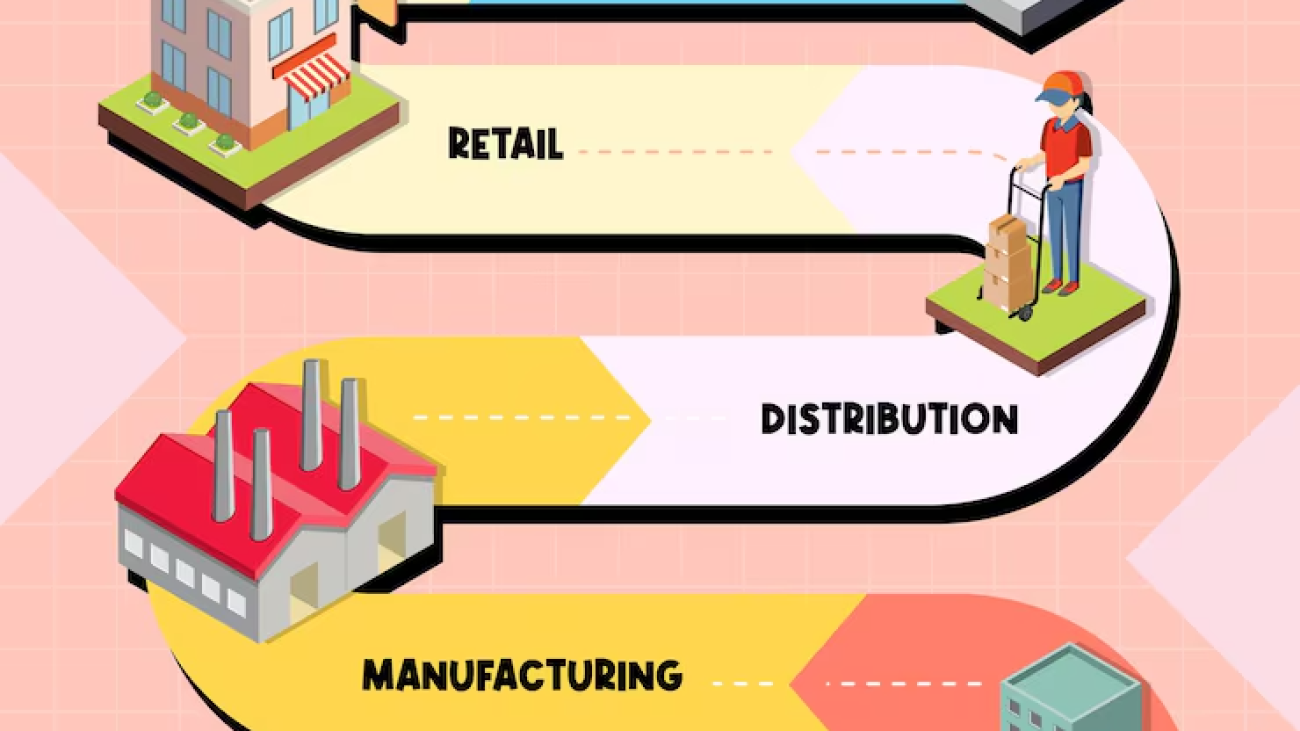
Supply Chain Doesn’t Break in One Place. It Breaks Across the System.
Most organizations believe supply chain problems come from:
- Procurement delays
- Inventory shortages
- Logistics inefficiencies
But in reality, the issue is deeper.
In high-performing systems like McDonald’s, supply chain is not a function.
It is an integrated performance system driven by KPIs.
The 5 Critical Supply Chain Layers
Every supply chain operates across:
- Demand Planning
- Procurement
- Inventory Management
- Logistics & Distribution
- Operations Execution
If one layer fails, the entire system feels the impact.
Where Most Companies Go Wrong
They measure KPIs in isolation.
But KPIs are interconnected.
Let’s look at how.
Demand Planning
Forecast Accuracy determines everything.
If forecast accuracy drops:
→ Overstock → Waste increases
→ Understock → Sales lost
Example:
Forecast = 1,000 units
Actual = 1,200
Accuracy drops → operational stress begins.
Procurement
Supplier performance drives availability.
Key KPIs:
- On-time delivery
- Cost per unit
- Quality consistency
But focusing only on cost is dangerous.
Lower cost suppliers can increase:
→ Waste
→ Preparation time
→ Service delays
Inventory Management
Inventory is a balancing act.
Too much:
→ Waste
→ Holding cost
Too little:
→ Stockouts
→ Lost revenue
Key metrics:
- Inventory turnover
- Days of inventory
- Stock availability %
Logistics & Distribution
Execution depends on delivery reliability.
Key KPI: OTIF (On-Time In-Full)
If deliveries are late or incomplete:
→ Kitchen delays
→ Service slows
→ Customer satisfaction drops
Operations (Where Money Is Made)
This is where supply chain becomes revenue.
Key KPIs:
- Service time
- Waste %
- Throughput
- Labor productivity
Example:
A delay in supply chain leads to:
→ Slower service
→ Fewer customers served
→ Lower revenue
The Real Problem: KPI Misalignment
Let’s take a simple example:
- Procurement reduces cost
- HR reduces staffing
- Kitchen reduces waste
Sounds efficient.
But together?
→ Service slows
→ Customers leave
→ Revenue drops
Efficiency without alignment destroys strategy.
The Critical Insight
Supply chain KPIs must work as a system, not as individual targets.
Improving one KPI while ignoring others can reduce overall performance.
What High-Performing Organizations Do Differently
Organizations like McDonald’s:
- Align KPIs across all functions
- Monitor performance in real time
- Empower supervisors to act immediately
- Translate KPIs into daily behavior
They don’t wait for monthly reports. They control performance every hour.
The Executive Question
Ask yourself:
- Which KPI in your supply chain directly impacts profit?
- Where does misalignment exist?
- Who is controlling performance daily?
If these answers are unclear, your supply chain is operating with hidden risks.
OTP Framework (Visibility → Accountability → Control → Profit) View Point:
Most companies think supply chain problems are operational. They are not. They are execution system failures. In high-performance models like McDonald’s, supply chain success is not about logistics alone. It is built on four pillars:
Visibility → Accountability → Control → Profit (OTP Framework)
1.VISIBILITY
If you cannot see it, you cannot manage it.
Across the supply chain:
- Demand Planning → Forecast accuracy
- Procurement → Supplier delivery performance
- Inventory → Stock levels & turnover
- Logistics → Delivery status (OTIF)
- Operations → Service time, waste %, throughput
Example:
If forecast accuracy drops from 95% to 80%:
→ Inventory imbalance begins
→ Stockouts or overstock
→ Operational stress
Without visibility, problems are discovered too late.
2️.ACCOUNTABILITY
If no one owns it, no one fixes it.
Each KPI must have a clear owner:
- Demand Planner → Forecast accuracy
- Procurement Manager → Supplier reliability
- Inventory Controller → Stock levels
- Logistics Manager → Delivery performance
- Operations Manager → Service & waste
Example:
If stockout happens:
Who is responsible?
- Procurement?
- Forecasting?
- Logistics?
Without accountability, problems become excuses.
3️. CONTROL
Real performance is controlled in real time.
This is where most organizations fail.
They:
- Review monthly reports
- Discuss problems
- Delay decisions
But execution leaders act immediately.
Example:
Late supplier delivery detected:
Action:
- Activate backup supplier
- Adjust inventory buffer
- Re-prioritize menu items
In operations (like McDonald’s):
- Service time increases → supervisor reallocates staff instantly
- Waste increases → batch production adjusted immediately
Control = speed of correction.
4️.PROFIT
Every KPI must translate into financial impact.
Supply chain is not cost-focused only.
It is profit-driven.
Example:
Improving waste from 6% → 4%:
→ Immediate cost saving
→ Direct margin improvement
Reducing service time:
→ Higher throughput
→ More customers served
→ Revenue increase
The Real Problem: KPI Misalignment
Many organizations operate like this:
- Procurement → Reduce cost
- HR → Reduce labor
- Operations → Increase speed
Result?
→ Slow service
→ Poor quality
→ Customer dissatisfaction
→ Revenue loss
The OTP Insight
Supply chain performance improves only when:
✔ KPIs are visible
✔ Ownership is clear
✔ Control is immediate
✔ Profit impact is measured
What High-Performing Organizations Do
Organizations like McDonald’s:
- Monitor KPIs in real time
- Align every function to one strategy
- Empower supervisors to act instantly
- Translate KPIs into daily operational behavior
They don’t manage supply chain.
They manage execution.
Final Thought
Supply chain excellence is not about complexity.
It is about clarity.
Visibility → Accountability → Control → Profit
If one pillar is weak, performance drops.
If all four are aligned, execution becomes predictable.
Supply chain is not about moving products.
It is about protecting revenue, controlling cost, and delivering consistent customer experience.
And that only happens when:
Strategy → KPIs → Execution → Behavior
are fully aligned.
We deliver structured training programs in procurement, supply chain, logistics, and operational performance under Talent Consultancy (UAE), available both online and onsite.
Organizations interested in improving operational performance can connect for customized programs under Talent Consultancy (UAE).
#OperationalExcellence #SupplyChainManagement #OTPFramework #KPIs #BusinessStrategy #Leadership #TalentConsultancy