
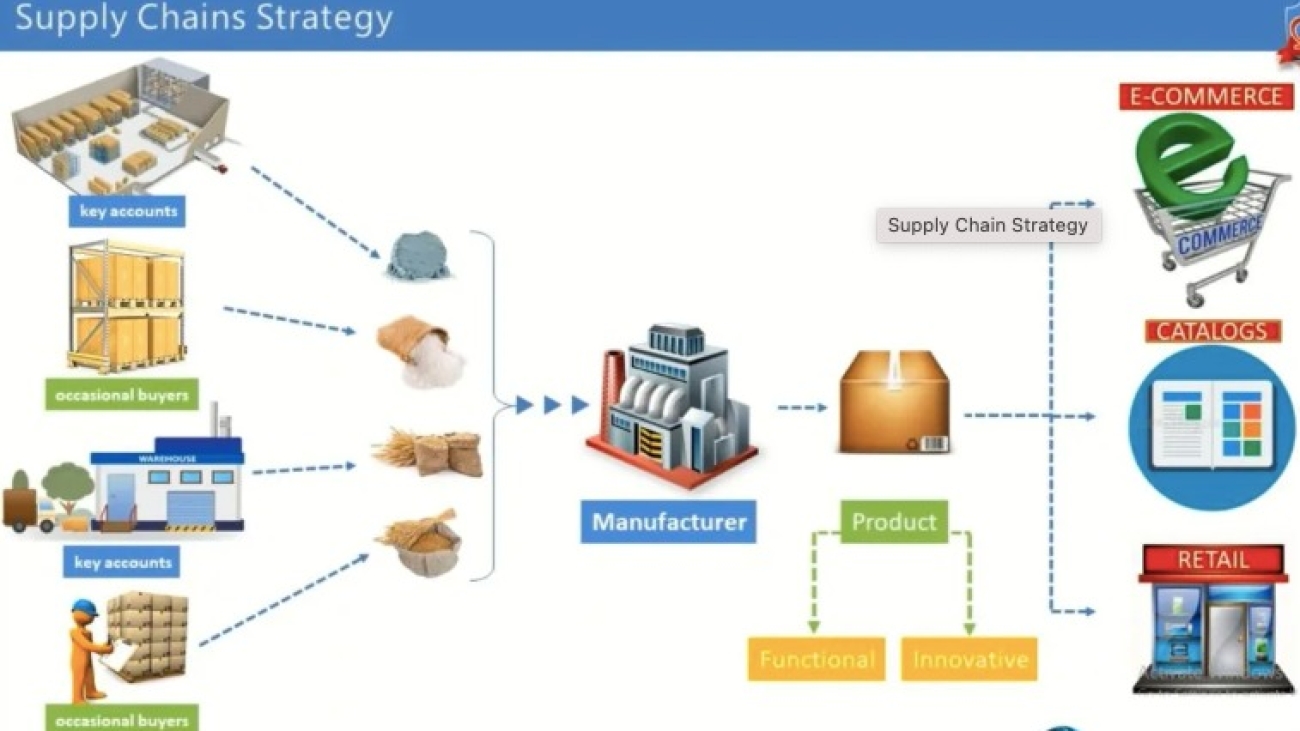
Linkage Between Ansoff Matrix Growth Strategies and Supply Chain Strategies in Business Performance
Business growth strategies are often developed using the Ansoff Matrix, which explains how organizations grow through products and markets. However, many organizations focus on growth strategy but fail to align their supply chain strategy, which leads to operational problems, high costs, and poor customer service.
At Talent Consultancy, we always emphasize that every growth strategy requires a different supply chain strategy. If the supply chain is not aligned with the growth strategy, business performance will suffer.
The Ansoff Matrix – Growth Strategies
The Ansoff Matrix includes four growth strategies:
| Existing Products | New Products |
| Existing Market | Market Penetration |
| New Market | Market Development |
So the four strategies are:
- Market Penetration
- Market Development
- Product Development
- Diversification
Each strategy requires different supply chain capabilities.
1. Market Penetration Strategy and Supply Chain Strategy
Market Penetration Strategy
This strategy focuses on:
- Selling more existing products
- In existing markets
- Increasing market share
- Increasing sales volume
- Competitive pricing
- Promotions and distribution expansion
Supply Chain Strategy Required
To support market penetration, supply chain must focus on:
- Cost efficiency
- High production capacity
- Efficient procurement
- Bulk purchasing
- Inventory availability
- Strong distribution network
- Logistics efficiency
- Demand forecasting accuracy
- Warehouse efficiency
Supply Chain Objective
Increase volume at lower cost while maintaining product availability.
Business Performance Impact
- Lower operational cost
- Higher sales volume
- Better product availability
- Faster order fulfillment
- Increased market share
- Higher profitability through volume
2. Market Development Strategy and Supply Chain Strategy
Market Development Strategy
This strategy focuses on:
- Entering new markets
- New countries
- New regions
- New customer segments
- Expanding distribution channels
Supply Chain Strategy Required
To support market development, supply chain must focus on:
- New distribution networks
- New warehouses or distribution centers
- International logistics
- Export/import procedures
- New supplier locations
- Packaging and labeling changes
- Demand planning for new markets
- Supply chain network design
- Logistics partnerships
- Regulatory compliance
Supply Chain Objective
Build supply chain network to support new markets efficiently.
Business Performance Impact
- Successful market expansion
- Better delivery performance
- Reduced logistics cost
- Improved customer service in new markets
- Smooth international operations
- Business growth
3. Product Development Strategy and Supply Chain Strategy
Product Development Strategy
This strategy focuses on:
- Introducing new products
- Innovation
- Product improvement
- Product customization
- New product features
Supply Chain Strategy Required
To support product development, supply chain must focus on:
- New suppliers
- Supplier development
- Flexible procurement
- Small batch purchasing
- Flexible production
- New materials sourcing
- Inventory for new materials
- Supplier collaboration
- Short lead times
- Quality control systems
Supply Chain Objective
Create flexible supply chain to support new product development and innovation.
Business Performance Impact
- Faster product development
- Innovation capability
- Competitive advantage
- Improved product quality
- Increased customer satisfaction
- Higher profit margins
4. Diversification Strategy and Supply Chain Strategy
Diversification Strategy
This strategy focuses on:
- New products
- New markets
- New business areas
- High growth but high risk strategy
Supply Chain Strategy Required
To support diversification, supply chain must focus on:
- New supplier base
- New logistics networks
- New warehouses
- New procurement strategy
- New inventory strategy
- Risk management
- Supply chain network design
- New distribution channels
- New technology systems
- Strategic partnerships
Supply Chain Objective
Build a completely new supply chain system to support new business areas.
Business Performance Impact
- Supports business expansion
- Reduces diversification risk
- Improves operational readiness
- Supports new business units
- Enables long-term growth
Summary – Ansoff Matrix and Supply Chain Strategy Linkage
| Ansoff Strategy | Supply Chain Focus | Supply Chain Objective |
| Market Penetration | Efficiency | Reduce cost & increase volume |
| Market Development | Distribution network | Support new markets |
| Product Development | Flexibility | Support new products |
| Diversification | New supply chain | Support new business |
This clearly shows that each growth strategy requires a different supply chain strategy.
Linkage Through the OTP Framework
The linkage between Ansoff Matrix and supply chain strategy can be explained using the OTP Framework (Operations → Transparency → Profit).
1. Visibility
Organizations must have visibility into:
- Supply chain costs
- Logistics costs
- Supplier performance
- Inventory levels
- Demand forecasts
- Delivery performance
- Supply chain risks
- Capacity utilization
Visibility ensures supply chain can support growth strategies effectively.
2. Accountability
Different growth strategies require different responsibilities:
- Procurement → Supplier capacity and cost
- Logistics → Distribution network
- Warehouse → Inventory availability
- Planning → Demand forecasting
- Finance → Cost control and investment
- Management → Strategy alignment
Accountability ensures supply chain supports growth execution.
3. Control
Control systems include:
- Supply chain KPIs
- Inventory control systems
- Supplier performance monitoring
- Logistics KPIs
- Demand planning systems
- Risk management frameworks
Control ensures supply chain supports growth strategy without increasing risk or cost unnecessarily.
4. Profit
When growth strategy and supply chain strategy are aligned:
- Expansion becomes smooth
- Costs are controlled
- Service levels improve
- Risks are managed
- Customers are satisfied
- Sales increase
- Profit increases
Therefore:
Growth Strategy → Supply Chain Strategy → Operational Performance → Customer Satisfaction → Profitability → Business Growth
Final Thought
Many organizations focus on growth strategies such as market expansion, new product development, or diversification, but they fail because they do not develop the supply chain capabilities required to support these strategies.
At Talent Consultancy, we always emphasize that growth strategies do not fail because of the market—they fail because the supply chain is not ready to support growth.
Because in business performance:
Companies do not grow because of strategy alone.
They grow when supply chains are designed to support that strategy.