
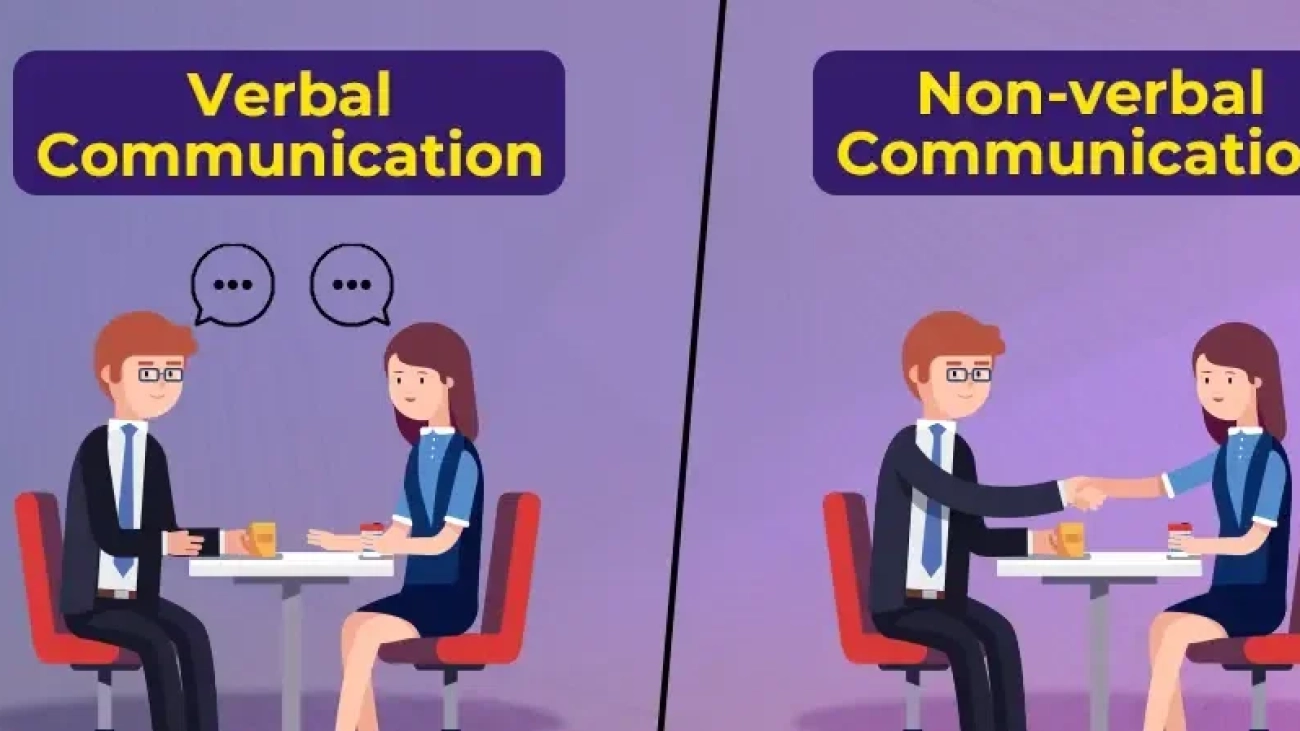
Verbal Communication and Non-Verbal Communication
1. Verbal Communication
What is Verbal Communication?
Verbal communication is communication using words — spoken or written — to share information, ideas, or feelings.
Simple training definition:
Verbal communication is the use of words to communicate with customers, colleagues, and managers.
Verbal communication includes:
- Face-to-face conversation
- Telephone conversation
- Meetings
- Presentations
- Emails
- Messages
- Reports
- Instructions
- Customer service conversations
Examples of Verbal Communication in Workplace
Example 1 – Reception
“Good morning, welcome to ABC Company. How may I help you?”
Example 2 – Telephone
“Thank you for calling. I will check this for you.”
Example 3 – Handling Complaint
“I apologize for the inconvenience. We will solve this problem immediately.”
Example 4 – Giving Instructions
“Please complete this form and submit it at the counter.”
Example 5 – Email Communication
“Dear Mr. Ali, please find attached the quotation you requested.”
All these are verbal communication.
Types of Verbal Communication
| Type | Example |
| Face to face | Talking to customer |
| Telephone | Customer call |
| Meeting | Staff meeting |
| Presentation | Training session |
| Customer email | |
| Written message | WhatsApp message |
| Report | Business report |
| Instructions | Work instructions |
Good Verbal Communication Skills
Employees must:
- Speak clearly
- Use simple language
- Be polite
- Be professional
- Listen carefully
- Avoid slang
- Avoid rude words
- Use positive words
- Confirm understanding
Positive Words to Use in Customer Service
| Instead of saying | Say this |
| I don’t know | Let me check for you |
| Wait | Thank you for your patience |
| Not possible | Let me see what I can do |
| That’s not my job | I will connect you with the right person |
| You are wrong | Let me clarify this for you |
| No | Unfortunately, we are unable to do that, but we can offer this |
Words can change customer experience.
2. Non-Verbal Communication
What is Non-Verbal Communication?
Non-verbal communication is communication without words — using body language, facial expressions, gestures, posture, tone of voice, and appearance.
Simple training definition:
Non-verbal communication is how we communicate without speaking.
Very important concept in training:
Customers believe what they see more than what they hear.
Types of Non-Verbal Communication
| Non-Verbal Communication | Example |
| Facial expression | Smiling, angry face |
| Eye contact | Looking at customer |
| Body posture | Standing straight |
| Gestures | Hand movements |
| Tone of voice | Friendly tone |
| Appearance | Uniform, grooming |
| Personal space | Standing distance |
| Handshake | Greeting |
| Listening posture | Nodding |
| Silence | Pausing |
| Environment | Office cleanliness |
Examples of Non-Verbal Communication in Workplace
Example 1 – Customer Reception
Poor Non-Verbal Communication:
- No eye contact
- No smile
- Looking at phone
- Slouching
- Angry face
Even if staff says:
“Welcome sir.”
Customer will not feel welcomed.
Good Non-Verbal Communication:
- Smile
- Eye contact
- Stand straight
- Friendly face
- Hand gesture to sit
Customer feels welcomed even before speaking.
Example 2 – Handling Complaint
Customer complaining.
Poor Non-Verbal:
- Rolling eyes
- Looking at computer
- Interrupting
- Crossing arms
- Angry face
Customer becomes more angry.
Good Non-Verbal:
- Eye contact
- Nod head
- Calm face
- Lean slightly forward
- Take notes
- Listen carefully
Customer feels respected.
Communication Rule (Very Important for Training)
Communication Impact Rule:
People remember communication based on:
- Words – 7%
- Tone of voice – 38%
- Body language – 55%
So:
Non-verbal communication is more important than verbal communication.
Comparison – Verbal vs Non-Verbal Communication
| Verbal Communication | Non-Verbal Communication |
| Words | Body language |
| What you say | How you say |
| Spoken or written | Facial expression |
| Email, phone, talking | Eye contact |
| Information | Feelings and attitude |
| Message | Emotion |
| Language | Tone, posture, gestures |
Simple explanation for training:
Verbal communication = Words
Non-verbal communication = Feelings
Workplace Example – Combined Communication
Staff says:
“I will help you.”
But:
- No eye contact
- Angry face
- Busy typing
- No smile
Customer will not believe the words.
But if staff:
- Smile
- Eye contact
- Friendly tone
- Open posture
Even simple words create great customer experience.
Points to Remember (Very Important for Training)
- Communication is not only speaking.
- Body language speaks before words.
- Smile is powerful in customer service.
- Eye contact shows confidence and respect.
- Tone of voice shows attitude.
- Posture shows professionalism.
- Listening is part of communication.
- Do not cross arms when talking to customers.
- Do not look at phone when customer talking.
- Appearance is also communication.
- Customers judge service by behavior.
- Good communication creates good customer experience.